Sparse mode protocol
This protocol details an example of 1 combination (2 drugs). Sparse mode can be scaled to screen 135 drugs (9,045 combinations).
See the Overview section for materials required.
1: Determine drug concentrations
Choose the desired drugs and their corresponding concentrations. Each drug will have 10 doses. As mentioned above, this example will detail how to screen 1 combination (2 drugs), but this can be adjusted according to experimental needs.
Start by choosing the maximum desired concentration of each drug. Check out the template below which takes the top chosen max concentration and makes a serial dilution according to the specified dilution factor:
You can customize this yourself by downloading a copy! File ➝ Download
The dilution factor is set to 1:3 by default (our recommendation), but this may be modified to anything (e.g. 1:2.5).
Check out the stock plate map (below the concentration ranges) for details on how this plate will look.
Stocks drugs must be soluble at 400X final desired concentrations.
2: Prepare the stock plate
Make the stock plate in a 384-well polypropylene (pp) plate that is Echo-compatible according to the following template:

(Use the spreadsheet template from step 1 to see details of how the plate should look).
We recommend volumes of 50 µL to maximize the number of assay-ready plates that can be made. Stock plates can be frozen until ready to make assay-ready plates.
Drug 1 in the top row, and Drug 2 in the bottom row
DMSO is plated in 4 wells to account for the ‘back-filling’ transfer steps
Staurosporine at a final concentration of (10 µM / 400 =) 25 µM is the cell death control
Ensure Staurosporine is an effective cell death control for your cell line before proceeding.
3: Prepare assay-ready plates
Use the stock plate to construct the assay-ready plates:
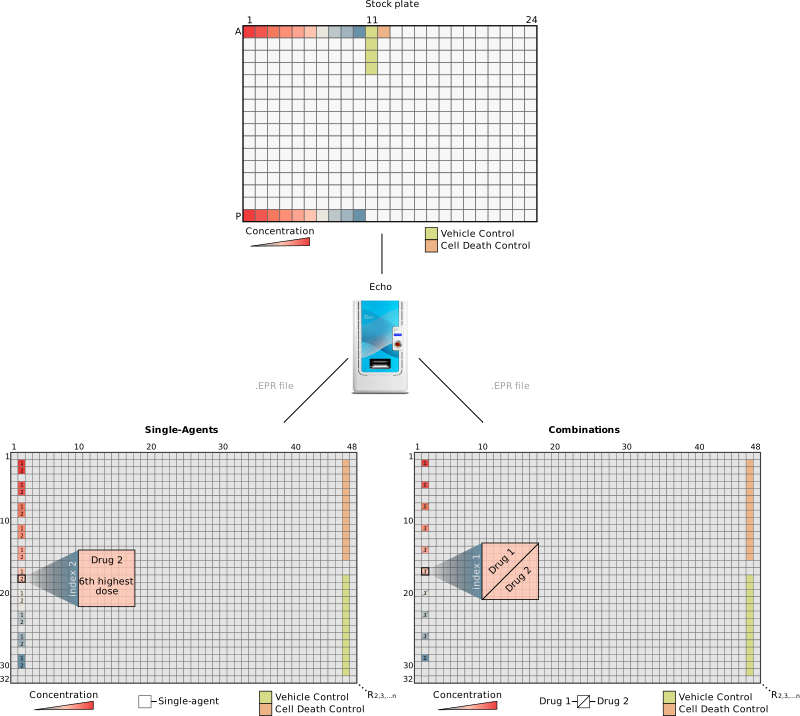
They’re called “assay-ready” because these plates are ready for cells to be added.
NoteUnlike dense mode, sparse mode has separate single-agent and combination plates.
Once plates are made, they can be stored at -80 °C until ready for cells.
The Echo requires an .EPR file to perform the transfer, so 2 are needed for sparse mode: one for single-agent (SA) plates and one for combination plates.
EPR files contain information on the source/destination wells, and volume to transfer.
The Combocat sparse mode EPR files for this example look like this:
Single-agent plate protocol
Combination plate protocol
Download the single-agent and combination EPR files from the combocat github and use them to make assay-ready plate:

You can modify these spreadsheets and import them each into the Echo software to make your own EPR files for scaling up the number of combinations.
4: Plate cells & incubate
Plate 4 µL of cells into all wells.
- This can be accomplished with a liquid handler like the Multidrop Combi or similar.
Incubate cells for desired treatment time
We recommend 72-hour treatments. After 96-hours, evaporation of media begins to disrupt data quality.
5: Measure viability
The following steps are specific to CellTiter-Glo
Equilibrate plate(s) to room temperature
Add 2 µL prepared CTG reagent
- Important
While the manufacturer recommends a 1:1 ratio, Do NOT dispense more than 2 µL of reagent. The total well volume should not exceed 6 µL – otherwise there is a risk of overflow. 😵
Centrifuge plates for ~4 minutes, ~1100 RPM
Incubate at room temperature for 10 minutes
Read viability on luminometer
Collecting data
Collect the raw luminescent data and save it as a .CSV file.
This file should contain only 1536-well format (32 rows by 48 columns) data, and nothing else (no headers or row names)
It is recommended to make a copy of your raw data and save a version containing only the required information, which will be used during the analysis.