Background
Let’s cover a bit about drug synergy and the details of the Combocat platform.
What is synergy?
In simple terms, synergy is a combination effect that exceeds expectations based on individual drug activities under established models like Bliss independence.
For example, let’s consider the following scenario:
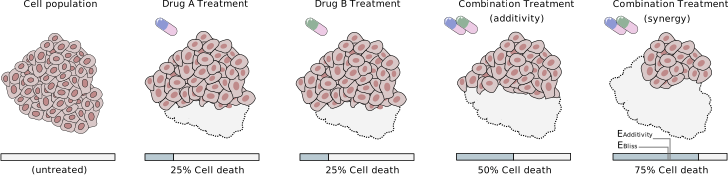
Drug A and Drug B each kill 25% of the cells. What would we expected the combined effect to be?
Additivity model
Under simple additivity, if the combination was purely additive then we would expect: 25% + 25% = 50% cell death. Anything higher would be greater than expected, thus synergistic. Anything lower would be less than expected, or antagonistic. So in the scenario above where we observed 50% cell death, this is an example of additivity.
Bliss model
The Bliss independence models assumes that the two drugs act independently of one another. We can plug in the single-agent values into the Bliss equation and easily get the % cell death expected under this model:
\[ 0.25 + 0.25 - (0.25 \times 0.25) = 0.4375 \]
or 43.75% cell death. So in the scenario above where we observe 75% cell death, this is synergy because the observed effect exceeds the expected one ✅
Loewe model
The Loewe model assumes that two drugs which share similar mechanisms can be compared based on how much of each would be needed alone to achieve the same effect as the combination. For example:
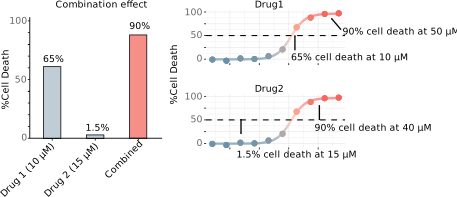
Loewe synergy can be calculated from doses used in the combination (d1, d2) and the doses that would produce the same effect as the combination (D1, D2):
\[ \frac{d_1}{D_1} + \frac{d_2}{D_2} = \frac{10}{50} + \frac{15}{40} = 0.575 \]
The interpretation of Loewe synergy is: <1 = synergistic and >1=antagonistic. This is synergy.
Combocat uses the Bliss model for its interpretability and robustness, although Loewe is supported as well. It’s important to be aware that various other models of synergy exist.
Dose “density”
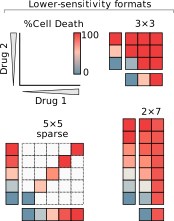
One of the biggest limitations in drug combination studies is the lack of sufficient dose density – the number of concentrations tested for each drug. Dense measurements across a broad range of concentrations are crucial for capturing complete drug response and synergy patterns. However, technical constraints in combination screening often lead to fewer doses tested, resulting in formats that may risk missing critical interaction details.
Advancements in liquid dispensing technology, like acoustic dispensing, have revolutionized compound transfer by enabling more flexible and precise experimental designs. Acoustic liquid handlers can dispense nanoliter volumes from any well of a source plate to any well of a destination plate without physical contact, greatly enhancing throughput potential.
We take advantage of this flexibility and designed screening templates that allow dense measurements. Specifically, Combocat tests drugs in a 10 ⨉ 10 format. Additionally, in “dense mode” (described below) there are 3 replicates of each matrix produced for each drug combination.
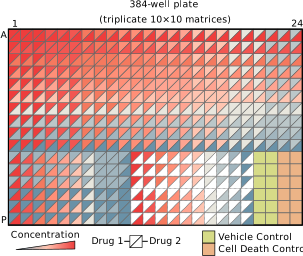
In this plate design, we fit three replicate 10 ⨉ 10 combination matrices, three 10-point dose-response curves for each single-agent, and 12 replicates of each control. Screening combinations in this dense format and with replicates captures much wider drug response and synergy landscapes.
Dense vs. Sparse mode
Combocat operates in two complementary modes called dense mode and sparse mode. While each is built for drug combination screening, they address different needs by using different approaches. Namely, sparse mode only measures a minimal set of conditions and uses machine learning to fill in the gaps:

Dense mode will be the best choice for most new users, while sparse mode is best for advanced users and high-throughput screens.
Dense mode features
Easily scales to tens-to-hundreds of combinations
Every combination is performed in triplicate within a plate
Highly reproducible and great as a validation screen
Sparse mode features
Ultrahigh-throughput scale – up to 9,045 combinations
Miniaturized assay (1536-well plates) consumes minimal resources
Great for primary screens testing many unique compounds
👉You can see more details about the differences between dense and sparse modes in the experimental sections.